
Данный проект является учебной работой студента Школы дизайна или исследовательской работой преподавателя Школы дизайна. Данный проект не является коммерческим и служит образовательным целям
Проект принимает участие в конкурсе
Исходный размер 3000x927

Duolingo logo // Official brand identity.

Исходный размер 2995x1634

Illustration from Duolingo official website.
post

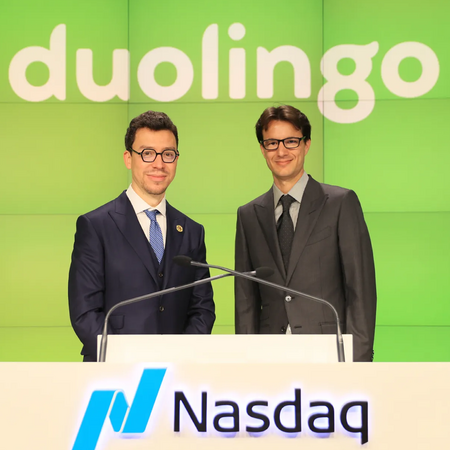
Founded in 2011 by Luis von Ahn and Severin Hacker, Duolingo was created in response to a broader issue of educational accessibility. The founders aimed to develop a digital service that could make language learning available to anyone regardless of geographical location or financial resources.

Over time, the project evolved into one of the most widely used educational applications in the world. Its growth reflects wider changes in digital learning practices, particularly the increasing role of mobile technologies and self-directed forms of education.

Brand Overview
post

BRAND POSITIONING

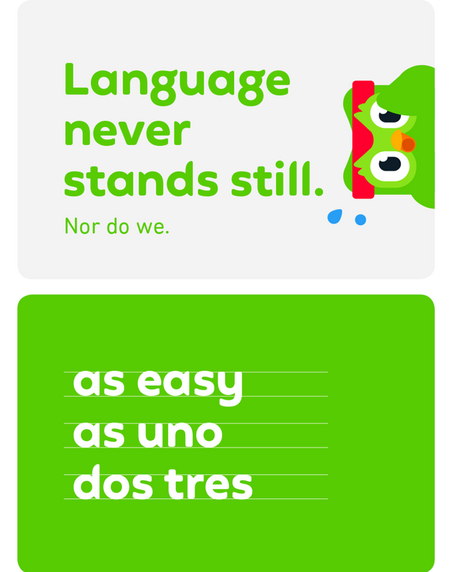
Duolingo positions itself as a convenient and engaging alternative to traditional language learning. Rather than focusing on formal instruction, the platform encourages users to build regular learning habits through short, interactive, and gamified lessons that fit easily into everyday routines.

The company describes its goal as becoming «The world’s most effective and enjoyable way to learn languages» reflecting its focus on combining educational value with user engagement.

post

TARGET AUDIENCE

Duolingo targets a broad international audience of language learners. While the platform is used by people of different ages and backgrounds, its strongest appeal is among younger users who are familiar with mobile technologies and digital platforms.

Users typically engage with the service for personal development, travel, educational goals, or career-related purposes.

FROM EDUCATIONAL PLATFORM TO MEDIA BRAND

Duolingo operates at the intersection of education, entertainment, and social media. Beyond its educational function, the platform has developed a strong online presence through its distinctive communication style and active participation in digital culture. As a result, the brand provides an interesting example of how contemporary organisations use digital platforms to attract attention, engage audiences, and maintain long-term relationships with users.

Channels & PR Strategy

Duolingo’s Main Communication Channels
Исходный размер 2389x164
post

Mobile App & Website

The mobile application and website remain the central communication environment of the brand. In addition to providing language courses, they encourage regular use through progress tracking, streaks, achievements, and personalised learning goals. As a result, the platform supports continuous interaction with users rather than occasional visits.
post

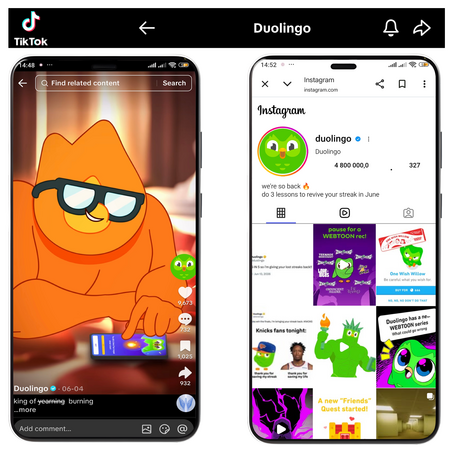
Tiktok

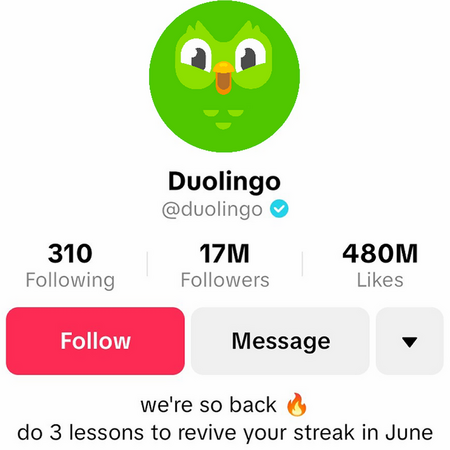
TikTok is currently Duolingo’s most visible social media channel. The company uses humour, trends, and the Duo mascot to participate in online culture and attract attention beyond the educational sector. Rather than promoting language courses directly, much of the content focuses on entertainment and brand personality, helping Duolingo remain highly recognisable among younger audiences.
post

*Instagram

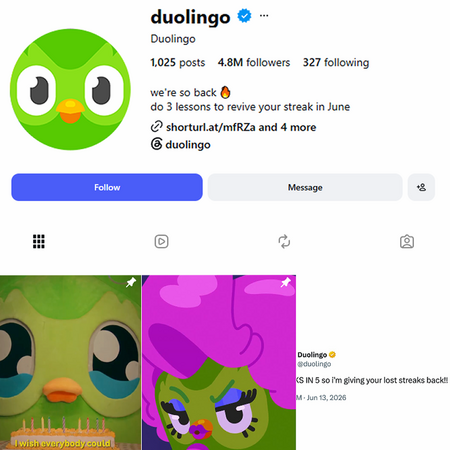
*Instagram serves as a platform for visual brand communication. Through short videos, illustrations, campaign materials, and user-focused content, Duolingo maintains a consistent brand image and stays connected with its audience between learning sessions.

(*Instagram is owned by Meta, which is recognized as an extremist organization and banned in Russia)
post

YouTube

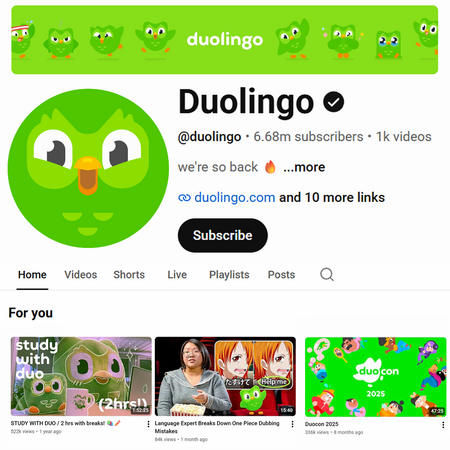
YouTube provides space for longer-form communication. The platform is used for promotional campaigns, educational videos, interviews, and brand storytelling. Compared with TikTok, YouTube allows the company to present more detailed content and communicate messages in greater depth.
post

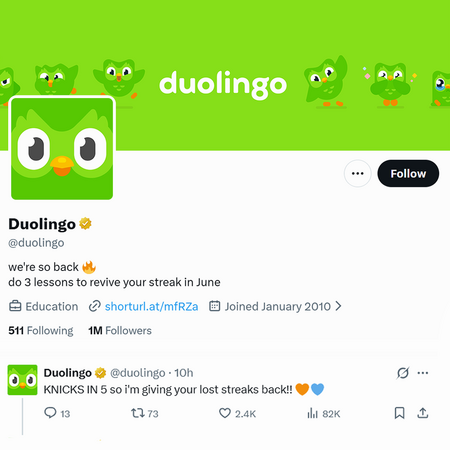
*Twitter (X)

On *X (Twitter), Duolingo engages in public conversations and responds to current events and online trends. The platform is particularly useful for direct interaction with users and for maintaining the informal and humorous tone that has become associated with the brand.

(*Twitter (X) is owned by X Corp., which is recognized as an extremist organization and banned in Russia)
post

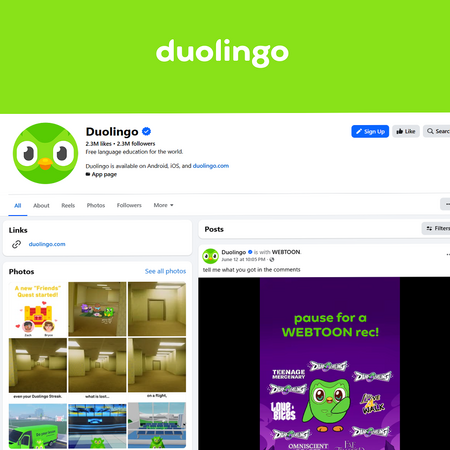
*Facebook

*Facebook functions primarily as an information channel. The company uses it to share updates, educational resources, and promotional materials. Although Facebook is less prominent in Duolingo’s communication strategy than TikTok or *Instagram, it remains useful for reaching broader demographic groups and international audiences.

(*Facebook is owned by Meta, which is recognized as an extremist organization and banned in Russia)

PR Strategy

Исходный размер 2547x1264

ANALYSIS

Uses and Gratifications Theory: Why Do People Engage With Duolingo?

post

Uses and Gratifications Theory, developed by Elihu Katz, Jay Blumler, and Michael Gurevitch in the 1970s, views audiences as active participants who choose media according to their own needs and motivations. Rather than asking how media influence people, the theory focuses on why people choose particular forms of media and what they gain from them. These motivations may include entertainment, self-development, social interaction, and the construction of personal identity.

Duolingo provides an interesting example because much of its audience engagement cannot be explained by educational needs alone.

While the platform was originally designed to help people learn languages, its public communication increasingly resembles that of an entertainment brand. This raises an important question: if users are looking for language education, why are some of Duolingo’s most successful posts completely unrelated to learning?
post

One explanation is that Duolingo understands how people use digital media. Most users do not open platforms such as TikTok or *Instagram with the intention of studying. They come to these spaces to be entertained, follow trends, interact with others, and participate in online culture. Rather than treating social media as a place for direct promotion, Duolingo adapts its communication to these existing audience behaviours (*Instagram is owned by Meta, which is recognized as an extremist organization and banned in Russia).This helps explain why many of Duolingo’s most successful posts contain little educational content. Rather than focusing solely on language learning, the brand relies on humour, trends, and the recognisable personality of Duo the Owl, placing itself within conversations that audiences are already having online.

TikTok videos from Duolingo’s official TikTok account.
post

Learning, however, remains central to the platform’s appeal. Unlike many brands that gain temporary visibility through viral content, Duolingo has managed to maintain users' interest over time. This is partly because the platform appeals not only to the desire for entertainment but also to the desire for self-improvement.

Language learning is often associated with personal development, career opportunities, travel, and cultural exploration. Users engage with Duolingo not only because the platform is enjoyable to use but also because it offers a practical benefit that aligns with their long-term goals. The brand consistently presents language learning as something accessible, manageable, and rewarding rather than difficult or intimidating.

This balance between entertainment and self-development is particularly important. Educational products often struggle because learning requires effort, while social media tends to reward immediate gratification. Duolingo attempts to bridge this gap by making learning feel less like an obligation and more like a rewarding daily habit.
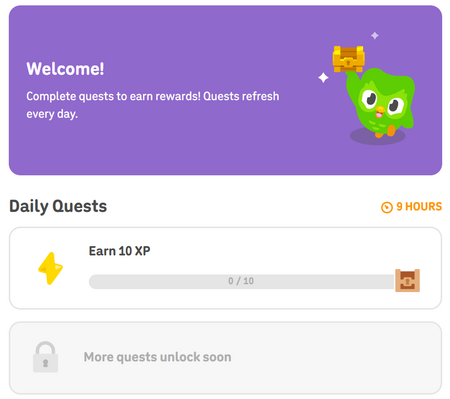
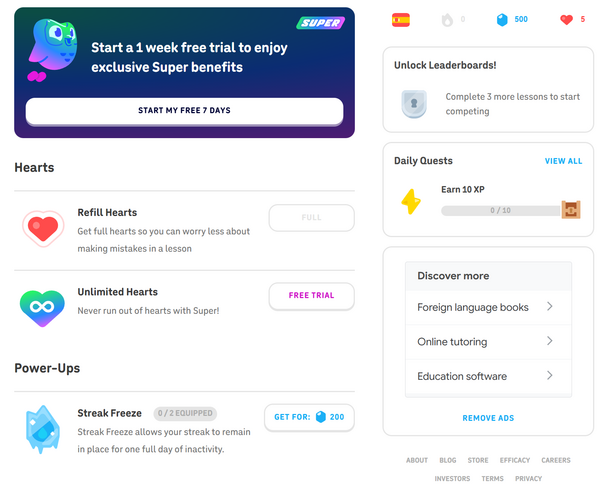
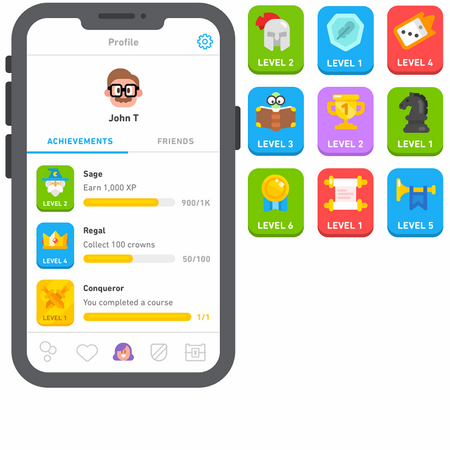
Duolingo interface — quests, rewards, and gamified learning system // In-app learning experience and progression mechanics.
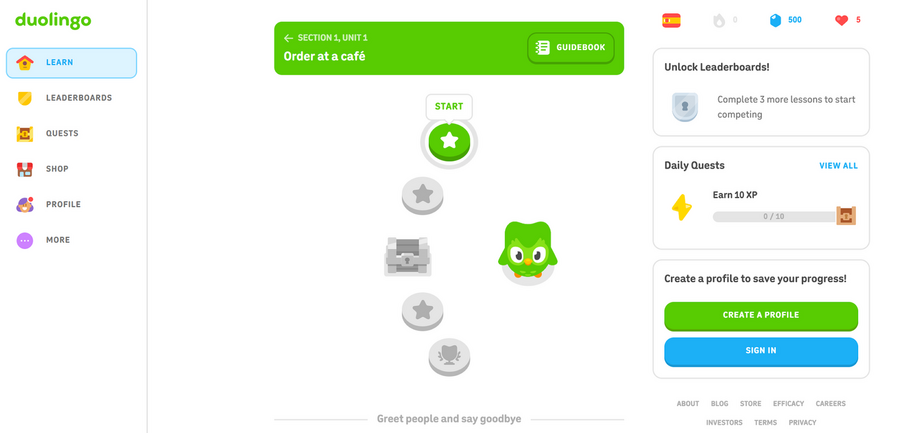
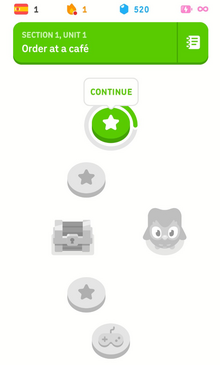
Duolingo’s home page for the web interface and for the mobile application
post

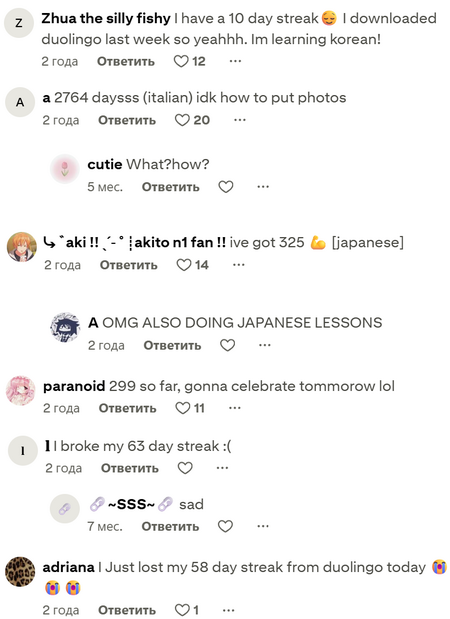
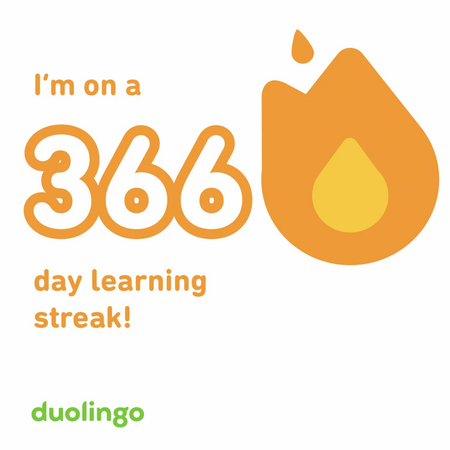
This focus on progress becomes especially visible through the platform’s achievement systems. Streaks, badges, leaderboards, and achievements are usually described as gamification features, but their significance extends beyond simple rewards. They provide users with visible evidence of improvement and encourage them to view learning as an ongoing commitment.

Over time, maintaining a streak can become more than simply completing lessons. For many users, it becomes a reflection of consistency, discipline, and personal effort. Achievement milestones are frequently shared online, celebrated by other learners, and incorporated into discussions within the community. Progress therefore becomes both a personal accomplishment and a social experience.

From this perspective, users are not only seeking educational outcomes. They are also looking for a sense of achievement, competence, and personal growth. Duolingo reinforces these motivations by making progress highly visible and by continuously reminding users of what they have already accomplished.
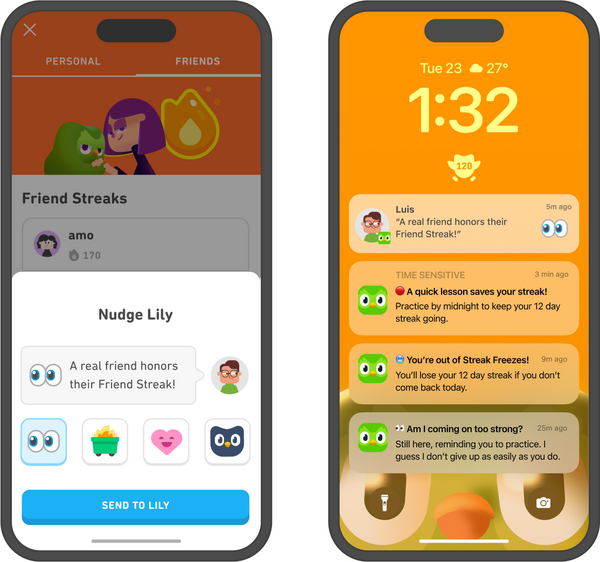
Friend Streak — Duolingo’s Latest Social Feature // User commentary on streaks on Pinterest.

post

The role of social participation is equally important. Many users interact with Duolingo beyond the learning platform itself. They comment on social media posts, create memes, share screenshots, discuss Duo’s behaviour, and participate in conversations surrounding the brand. Collaborations with franchises such as Genshin Impact further extend these interactions by connecting Duolingo to existing fan cultures.

These collaborations illustrate that Duolingo is not only competing with other educational platforms. On social media, it competes alongside creators, influencers, games, films, and entertainment brands that are all competing for audience attention. By embedding itself within popular online culture, Duolingo creates opportunities for interaction that go far beyond language learning.

People are often drawn to media that connects them with communities and identities that already matter to them. Duolingo benefits from this dynamic by linking language learning to broader forms of online participation. As a result, the brand remains relevant even in moments when education is not the audience’s primary motivation.

Duolingo × Genshin Impact collab // Comments under the official trailer on Duolingo’s YouTube channel.

Исходный размер 2542x1359

Duolingo × «Squid Game» collab // А screenshot from Duolingo’s official YouTube channel.

Dialogic Theory: How Does Duolingo Build Relationships With Its Audience?

post

Dialogic Theory of Public Relations, developed by Michael Kent and Maureen Taylor in the late 1990s, argues that effective communication is based on dialogue rather than one-way information transmission. Instead of simply distributing messages, organisations should create opportunities for interaction, participation, and relationship building with their audiences.

Duolingo’s communication strategy demonstrates this principle particularly clearly because the brand rarely communicates like a traditional company. Instead of presenting itself as a formal educational organisation, Duolingo interacts with audiences through the fictional personality of Duo the Owl.

This distinction is important because audiences often respond differently to characters than they do to corporations. Many users speak about Duo as if he were a real social media personality with emotions, intentions, and opinions. As a result, interactions feel less like communication with a company and more like participation in an ongoing narrative.The popularity of Duo demonstrates that audiences are often more willing to engage with personalities than with institutions. By creating a mascot capable of expressing humour, frustration, excitement, and even jealousy, Duolingo reduces the distance between the brand and its users.

Illustrations from Duolingo’s official TikTok account.

Duolingo’s poster for the animation series «The Final Test» // Audience reactions in the comments section of Duolingo’s official YouTube video.

post

One of the clearest examples of dialogic communication can be found in Duolingo’s comment sections.

The brand frequently responds to users directly and rarely relies on formal corporate language. Instead, replies often imitate the tone, humour, and style of the surrounding conversation. In many cases, users engage with Duolingo specifically in the hope of receiving a response from the official account.

These interactions are important because they transform audiences from passive receivers of information into active participants in communication.

The value of the interaction does not come from the information itself but from the feeling of being acknowledged by the brand. From the perspective of Dialogic Theory, this demonstrates a commitment to relationship building rather than simple message distribution.

Examples of interactions by Duolingo’s official *Twitter (X) account with users // Examples of interactions by Duolingo’s official TikTok account with users.

post

A particularly interesting aspect of Duolingo’s communication strategy is the development of the «Evil Duo» narrative.

Originally, reminders to complete lessons were intended to encourage learning behaviour. However, audiences gradually transformed these reminders into a running joke in which Duo became an intimidating figure who watches users and punishes them for missing lessons. What makes this example significant is that the narrative was not created entirely by the company. Users actively participated in shaping and expanding it through memes, videos, comments, and jokes. Rather than rejecting these interpretations, Duolingo embraced them and incorporated them into its own communication.

This demonstrates one of the central ideas of Dialogic Theory: meaning is created collaboratively. Communication is not simply transmitted from an organisation to an audience. Instead, both sides contribute to the development of shared narratives and cultural meanings.

Исходный размер 1996x325

Duolingo’s streak reminder notifications featuring different emotional expressions of the Duo mascot.

Halloween-themed promotional image published by Duolingo on social media // User-generated meme inspired by Duolingo’s online brand image.

post

Perhaps the strongest evidence of successful dialogic communication is the the amount of user-generated content surrounding the brand. Users regularly create memes, edits, fan art, parody videos, and discussions inspired by Duolingo. Importantly, this content often spreads independently of official communication channels. The audience does not merely react to brand messages; it actively extends and transforms them. From a dialogic perspective, this suggests a highly engaged relationship between the organisation and its publics. Users are not passive consumers of content but active participants in the ongoing construction of the brand’s identity.

The success of Duolingo therefore depends not only on what the company communicates but also on what audiences choose to do with those messages after receiving them.

Art by @__j00l on TikTok // Art by @maochi_il on TikTok.

Critical Evaluation

The analysis suggests that Duolingo’s communication strategy is effective because it combines educational goals with entertainment, participation, and community building. Rather than positioning itself solely as a language-learning platform, the brand has become part of broader digital culture.

However, this strategy also creates potential risks. The strong focus on entertainment sometimes overshadows the educational purpose of the platform. Many users are familiar with Duo’s online personality but may know little about Duolingo’s actual learning tools. Furthermore, the brand’s humour relies heavily on internet culture and may not resonate equally with all audience groups. Despite these limitations, Duolingo demonstrates how contemporary organisations can use entertainment, dialogue, and audience participation to build long-term relationships with users.

The platform’s success illustrates that in digital environments, engagement is often driven not only by information and utility but also by identity, community, and shared cultural experiences.

Библиография
1.

Duolingo Learn [Электронный ресурс]. — Режим доступа: https://www.duolingo.com/learn (дата обращения: 10.06.2026).

2.

Duolingo Official Website [Электронный ресурс]. — Режим доступа: https://www.duolingo.com (дата обращения: 10.06.2026).

3.

Duolingo Blog [Электронный ресурс]. — Режим доступа: https://blog.duolingo.com (дата обращения: 10.06.2026).

4.

Duolingo YouTube Channel [Электронный ресурс]. — Режим доступа: https://www.youtube.com/@duolingo (дата обращения: 10.06.2026).

5.

Duolingo TikTok Account [Электронный ресурс]. — Режим доступа: https://www.tiktok.com/@duolingo (дата обращения: 10.06.2026).

6.

Duolingo Instagram Account [Электронный ресурс]. — Режим доступа: https://www.instagram.com/duolingo (дата обращения: 10.06.2026).

7.

Duolingo X (Twitter) Account [Электронный ресурс]. — Режим доступа: https://x.com/duolingo (дата обращения: 10.06.2026).

8.

Duolingo Facebook Page [Электронный ресурс]. — Режим доступа: https://www.facebook.com/duolingo (дата обращения: 10.06.2026).

9.

Katz, E., Blumler, J. G., & Gurevitch, M. (1974). Utilization of Mass Communication by the Individual. In J. G. Blumler & E. Katz (Eds.), The Uses of Mass Communications: Current Perspectives on Gratifications Research. Beverly Hills: Sage Publications.

10.

Kent, M. L., & Taylor, M. (1998). Building dialogic relationships through the World Wide Web. Public Relations Review, 24(3), 321–334.

Источники изображений
1.

Duolingo Learn [Электронный ресурс]. — Режим доступа: https://www.duolingo.com/learn (дата обращения: 10.06.2026).

2.

Duolingo Design System [Электронный ресурс]. — Режим доступа: https://design.duolingo.com/identity (дата обращения: 10.06.2026).

3.

Pinterest [Электронный ресурс]. — Режим доступа: https://ru.pinterest.com (дата обращения: 10.06.2026).

4.

Duolingo TikTok Account [Электронный ресурс]. — Режим доступа: https://www.tiktok.com/@duolingo (дата обращения: 10.06.2026).

5.

Duolingo YouTube Channel [Электронный ресурс]. — Режим доступа: https://www.youtube.com/@duolingo (дата обращения: 10.06.2026).

6.

New Duolingo Achievements // Dribbble [Электронный ресурс]. — Режим доступа: https://dribbble.com/shots/8560257-New-Duolingo-Achievements (дата обращения: 10.06.2026).

7.

Duolingo founders Luis von Ahn and Severin Hacker during IPO, July 2021 // Encyclopaedia Britannica [Электронный ресурс]. — Режим доступа: https://cdn.britannica.com/97/273497-050-3B229C6F/Duolingo-founders-Luis-von-Ahn-and-Severin-Hacker-during-IPO-July-2021.jpg (дата обращения: 10.06.2026).

8.

Duolingo JB Font Samples [Электронный ресурс]. — Режим доступа: https://i2.wp.com/www.underconsideration.com/brandnew/archives/duolingo_jb_font_samples.png (дата обращения: 10.06.2026).

9.

Duolingo Streak Illustration [Электронный ресурс]. — Режим доступа: https://static.wikia.nocookie.net/duolingo/images/0/0e/366_streak_-_square.PNG/revision/latest/scale-to-width-down/1000 (дата обращения: 10.06.2026).

10.

Friend Streak Nudge // Ghost Blog [Электронный ресурс]. — Режим доступа: https://storage.ghost.io/c/7a/33/7a33d0f4-927d-4fe8-a6bf-96131b5e76d4/content/images/2024/07/friend-streak-nudge.png (дата обращения: 10.06.2026).

11.

Duo at Home // Ghost Blog [Электронный ресурс]. — Режим доступа: https://storage.ghost.io/c/7a/33/7a33d0f4-927d-4fe8-a6bf-96131b5e76d4/content/images/2022/09/Duo-at-home.png (дата обращения: 10.06.2026).

12.

Duolingo Official X (Twitter) Account [Электронный ресурс]. — Режим доступа: https://x.com/duolingo (дата обращения: 10.06.2026).

13.

Duolingo [Электронный ресурс]. — Режим доступа: https://www.instagram.com/duolingo/?utm_source=ig_web_button_share_sheet (дата обращения: 10.06.2026).

14.

Duolingo [Электронный ресурс]. — Режим доступа: https://www.facebook.com/duolingo (дата обращения: 10.06.2026).