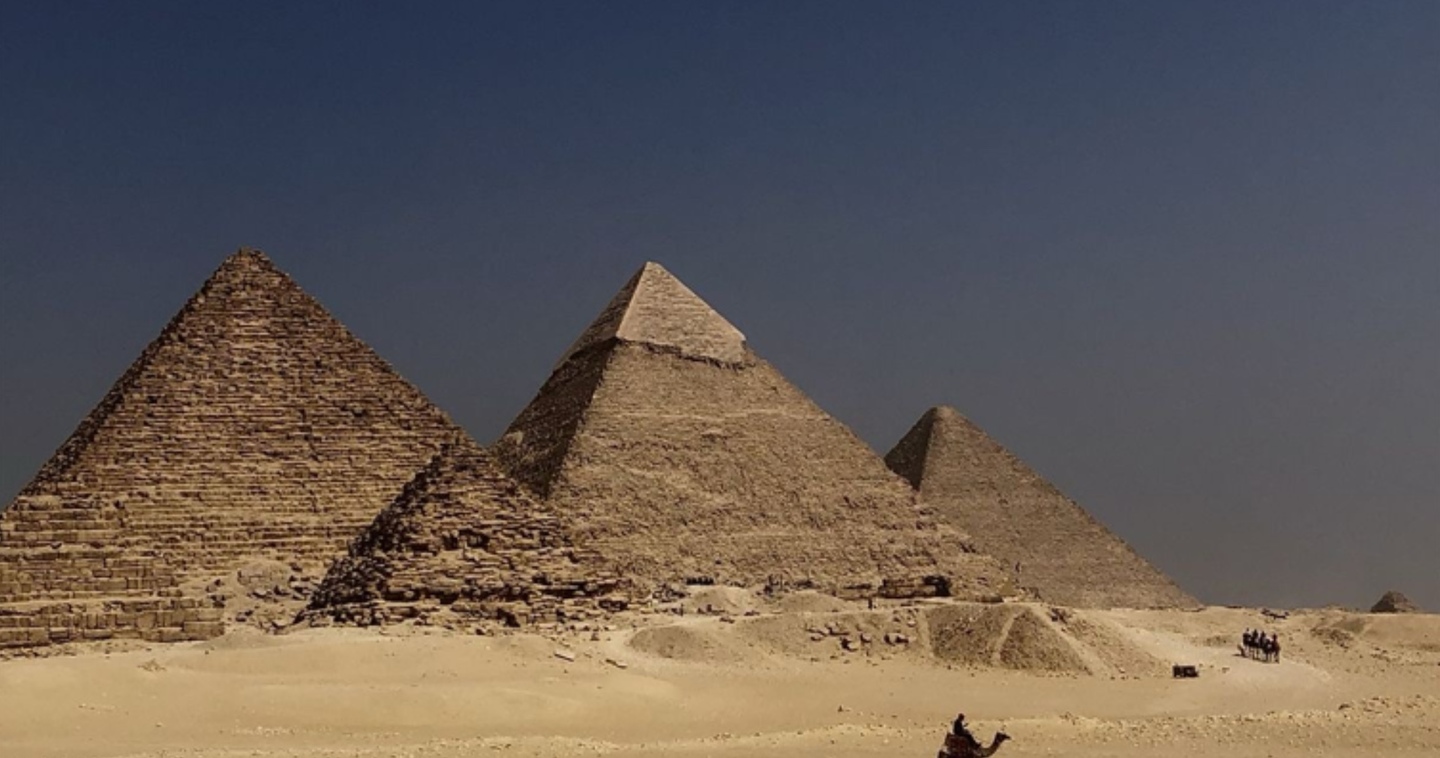
Navigator
1. Concept
2. Format Evolution
3. Map Legend
4. Time as Space
5. Bestiary of Guardians. Final Point of the Journey
Concept:
Throughout human history, people have wondered what awaits us after death. Most cultures have myths and legends to answer this question, and Ancient Egypt was no exception. The Egyptians believed that the afterlife had boundaries, numerous obstacles, and inhabitants—and therefore, a distinct journey for the soul of the deceased. Beginning with the Middle Kingdom (circa 2040 BCE), a complete visual topography of the Duat emerged; they placed these depictions in tombs to facilitate the human passage after death. Today, we would call this a map. How did ancient Egyptian artists transform the concept of the afterlife into a legible visual system, and how did this system evolve as the medium changed?
Material Selection Principle:
We selected monuments where Duat is depicted as a journey one must undertake. The Old Kingdom period (2700–2200 BCE) was intentionally omitted from this study because the ancient Egyptians’ conceptions of the afterlife during that time differed significantly. In the Old Kingdom, Duat was located in the heavens, not underground, and was accessible only to pharaohs—and only they possessed funerary texts. Other people, including high-ranking officials, believed that their afterlife depended solely on the king’s grace. Beginning with the Middle Kingdom, these concepts changed—the «right» to eternal life became available to everyone, and Duat transformed into an underworld filled with traps, as the deceased needed a map.
Hypothesis:
The depiction of Duat evolved from a map into a collection of symbols and signs. The Egyptians were not striving for «geographical accuracy,» as the map’s purpose was to allow the Soul to read it and pass through. Therefore, artists relied not on perspective, but on rigid codes: color, registers, and geometry.
Evolution of the Format
The earliest depictions of Duat appear during the Middle Kingdom. They were placed closest to the deceased’s body, specifically within the wooden sarcophagus. In the Deir el-Bersha necropolis, the Book of Two Ways was drawn on the bottom of the sarcophagus, directly beneath the deceased’s back.
Book of Two Ways. Gua Wooden Coffin. (c. 2055–1650 BCE)
It depicts a bird’s-eye view: two paths—a black terrestrial path and a blue aquatic path—divided by a fiery lake and leading toward Rostau, the domains of Osiris. The hieroglyphs here are part of the schematic; columns of text fill the voids to form the «walls» and «corridors» of the plan. The image is executed on wood, using a palette of black and blue paints.
Pharaonic fungal growth from Thutmose III (15th century BCE) Valley of the Kings, Egypt
During the New Kingdom, both the medium and the point of view shift. The composition moves onto the walls of the royal tombs in the Valley of the Kings, and the plan gives way to the profile cross-section: the space is unfolded into horizontal registers, which are read from left to right, like a ribbon. In the tomb of Thutmose III at Amduat, outline drawings and hieratic script are inscribed onto white plaster, causing the walls of the burial chamber to resemble an unrolled papyrus.
Papyrus of Ani. 19th Dynasty (c. 1250 BCE, reign of Ramesses II)
Concurrently, a third format emerges: the papyrus scroll. The Book of the Dead was created for the elite and placed in the sarcophagus alongside the mummy. The sequence of small, colored scenes interspersed with text makes it the most «readable» version of the maps.
Papyrus of Hunefer. Circa 1310–1275 BCE (19th Dynasty, New Kingdom period).
Map Legend
Ancient Egyptian artists did not employ linear perspective. Therefore, they coded the landscape of the afterlife using symbols that we would today call a map legend. The soul needed to quickly determine where a path led and where danger lay, so every element was drawn according to a consistent canon. The oldest «legend» is found in the Book of Two Ways. It is structured around color: black represented the terrestrial path, and blue represented the aquatic path. Between them lay a fiery barrier. Thus, color functions as navigation within the map.
Gua Sarcophagus. (Middle Kingdom, c. 1985–1773 BCE)
Sarcophagus of Sen. (c. 1850 BCE)
In the Book of the Dead, the lake of fire becomes an independent vignette: a rectangular body of water edged with hieroglyphs of fire and four peacocks. Since the ancient Egyptians always depicted water with zigzags (which is also the sign of the hieroglyph), the lake is immediately legible without a caption.
Papyrus of Ani. 19th Dynasty, New Kingdom (c. 1250 BCE).
In the Book of Gates, the space is divided into segments by gate panels. Each gate is guarded by snakes and sentinels, and the boundary between zones becomes the primary compositional element. Caves and mounds are depicted using circular or oval shapes, within which mummies and deities reside.
Book of Gates. Tomb of the Network I. (c. 1290–1279 BCE).
Time as Space
In Amduat, each of the twelve hours of the night becomes a distinct realm of Duat. Time here functions as a space the soul must traverse. Every hour is structured identically: three horizontal bands (registers). In the center flows the underworld river, upon which Ra’s barque sails. The upper and lower registers depict the banks populated by the denizens of Duat. The hours are separated by vertical columns of text detailing the hour’s name and the gate’s title. The barque moves from left to right, and the time can be read by following its passengers—in the early hours, Ra is depicted with the head of a ram (his nocturnal form), but in the twelfth hour, he is reborn as Khepri.
1st hour of the Amduat, papyrus of Nesmina, 300–275 BCE.
12th hour, birth
The dramatic center of the night is the midpoint of the journey: at the sixth hour, Ra unites with the body of Osiris, and at the seventh hour, he confronts Apep, the serpent of chaos, whose body is pierced by knives and bound.
Hour 7, Apophis (from the Tomb of Thutmose III)
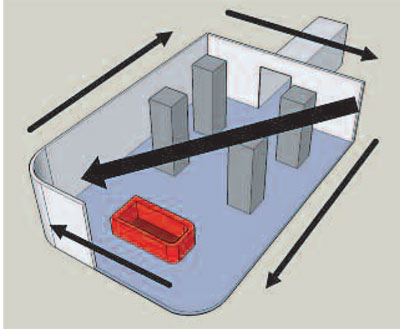
In the tomb of Thutmose III, this principle was realized in architecture: the clocks do not stand in a straight line, but encircle the walls of the burial chamber (the first three to the right of the entrance, the fourth on either side of it), and the sarcophagus is placed next to the last clock. The person entering the chamber spends the night with Ra.
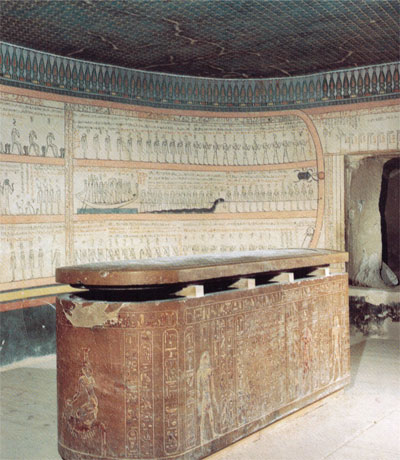
- The Chamber of Thutmose III A photograph of the chamber with the sarcophagus against the curved wall.
- Diagram of the clock traversal around the walls.
Bestiary of Guardians and the Final Destination
One cannot pass through the Duat without naming its guardians. In the Book of the Dead, before every gate, the deceased utters memorized words. In Ani’s papyrus, three figures stand at the gates: the gatekeeper, the observer, and the herald. In the Book of Gates, the borders between the hours are formed by massive doors guarded by fire-breathing serpents. The guardian is first and foremost a symbol of the boundary, which is why it is drawn angular and instantly recognizable.
Gates and Guardians in the Book of the Dead, the Ankh-eye Papyrus (c. 1186–945 BCE)
In the final map, the narrative narrows to two scenes. The Judgment of Osiris is structured along a strict axis. In the Book of the Dead of Hunefru, Anubis leads the deceased to the scales—the heart is weighed against the feather of Ma’at—Thoth records the result, and Ammit, a hybrid of crocodile, lion, and hippopotamus, sits beneath the scales.