Curricular Mentorship Project. An exhibition of this nature does not exist—it is a concept developed within the framework of the course.
«Without Us» is a monograph exhibition project by Vladimir Chernyshov about the world that continues to exist after a person has left it. I propose showcasing it at Les Abattoirs—a museum of contemporary art in Toulouse housed in the building of a former municipal slaughterhouse.
Кураторский текст
Imagine a room where someone was just present. The door isn’t shut, objects are in place, but the person is gone. An exhibition grows from this sensation. Its subjects aren’t people, but what remains of them: a first-aid kit made of rusted nails, a pair of crutches, a candle that no one can light, a staircase descending into black water.
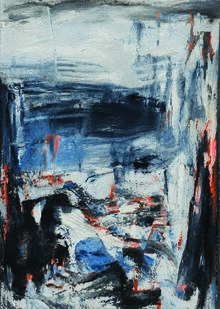
The exhibition features ten works from 2020–2026, ranging from small objects and sheets covered in soot and wax to the installation «Pool, ” which measures 6 by 8 meters. The visitor’s journey progresses from the small to the large, and the building—having changed its function—becomes an active participant in the dialogue about temporality. The exhibition does not sensationalize catastrophe or lecture visitors. Instead, it invites them to temporarily inhabit a world without us, in order to see the world with us more clearly.

Why Vladimir Chernyshov
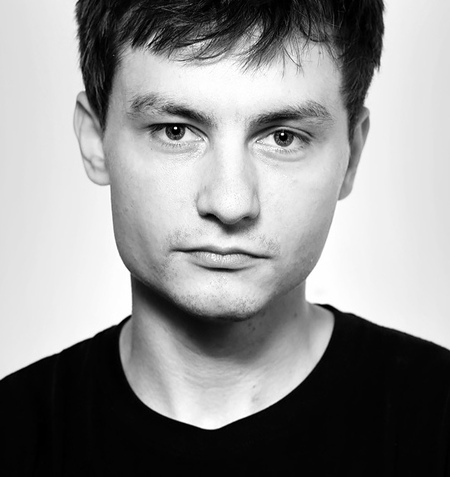
I chose Chernyashov for four reasons. Each reason is not only a characteristic of the artist but also an argument for why this exhibition should happen now and in this specific location.
1. A Universal Theme Chernyashov’s practice speaks the language of ecology. He explores the relationship between humanity and nature through decay and entropy—through how things age, are overtaken by nature, rust, and lose their function. In the face of a climate crisis, this statement becomes particularly urgent. Yet, the artist does not deliver lectures or display catastrophe directly. His quiet tone positions the viewer not as a culprit, but as an observer. I believe this kind of tone is what can connect with an audience tired of alarming headlines today.
2. Material as Statement Chernyashov speaks not through imagery, but through material. Soot is the residue of a fire that is gone. Wax preserves form, but melts easily. Pitch reminds us of roads and roofs—that is, what humans cover the earth with. Rusty nails and old wood bring into the work the time lived outside the studio. His works age and darken, and this is not a flaw, but part of the meaning. This language is universally understandable, which is crucial for a show abroad: everyone recognizes a first-aid kit, a walker, and a set of stairs.
3. Space as Co-Creator For Chernyashov, the venue is not a neutral white box, but a participant in the work. His early projects were made directly in abandoned villages in the Arkhangelsk region, and his solo exhibition, «The Penultimate Human on Earth» at the Sidur Museum (2022), was an experience where space became part of the discourse. An artist with this methodology requires a venue with its own history. Therefore, the choice of artist and the choice of location are directly linked in this project.
4. A Coherent Trajectory His journey reads like a sequence of four steps, where each subsequent step grows out of the previous one. The exhibition «Without Us» brings all four of these lines together in a single space.
Finally, the artist has international exhibition experience: in 2024, their work was shown in Dresden and London. For the French audience, the exhibition in Toulouse could be the first comprehensive introduction to their practice. For the artist, it is an opportunity to present their practice as a cohesive whole, and for the museum—a new name whose theme directly answers the history of its building.
WHY LES ABATTOIRS
Museum facade, Toulouse
Les Abattoirs, which translates from French as «slaughterhouses, ” is not a metaphor. The building, which was once used for slaughter, now showcases art. There is hardly a more fitting location for an exhibition on temporality.
The Toulouse Municipal Slaughterhouse was constructed between 1828 and 1831 under the design of architect Urbain Vitry on the banks of the Garonne. According to the architect’s vision, its layout mirrored the scheme of the Saint-Sernen basilica—the city’s main cathedral—so the industrial building began with an almost ecclesiastical form: a nave, side aisles, and a semi-circular apse. The slaughterhouse closed in the late 1980s, and in 2000, after reconstruction by architects Antoine Stinko and Rémy Papillon, a museum opened on the site. The architects preserved the simplicity and unity of the exterior as a tribute to the place, while adapting the interior spaces for exhibitions. Today, it is Les Abattoirs, Musée — Frac Occitanie Toulouse: a museum of contemporary art and a regional contemporary art foundation under one roof.
Why this building is suitable for the exhibition
The building itself speaks to ephemerality. A place where violence once occurred now displays art, and here too, nothing remains the same. Everything is temporary: the material, the building’s function, and the person within it. An exhibition about the world after humanity enters a building from which its first life has already departed. The viewer enters under the facade’s arches and is immersed in the theme even before seeing the first piece of work.
Material contrast. Thin paper, wood, soot, and wax do not decorate the space; they coexist with the heavy brickwork of the former slaughterhouse. The fragile stands beside the robust, the personal—beside the industrial. Each side makes the other more noticeable.
The architecture dictates the path. Niches near the entrance suit small objects, while the long nave with arched openings is intended for arches and graphics, and the semicircle is the only space large enough to accommodate an 8×6 meter installation. The building, with its high, open volumes, is inherently suited for monumental works.
Water nearby. The museum sits on the Garonne, and the exhibition culminates in the theme of water. Leaving the «Pool, ” the viewer finds themselves just steps away from a real river.
- Institutional Profile. Les Abattoirs combines a museum and a regional contemporary art foundation (Frac): here, art is not only shown but also collected. A monographic exhibition with a site-specific logic fits this profile and requires no spatial reconfiguration.
The building changed its purpose just as the objects in the exhibition lost their owners.
Four Exhibition Concepts
The World After Humanity The title continues the artist’s core theme—a «world without us.» This is a world where humans are gone, yet traces of their presence remain. These are not monuments, but everyday objects: a first-aid kit, a walker, a notebook, a ladder. While people are around, we don’t notice them. But once they are gone, the objects begin to speak for themselves.
Monograph, Not Retrospective The exhibition does not organize works by year nor does it recount a biography. Instead, it presents a statement centered on a single theme, compiled from ten works created over the last six years. It selects one line of the artist’s practice and traces its progression.
Dialogue with the Building The works do not simply reside in the halls; they engage in a conversation with the architecture of the former slaughterhouse. The building accentuates the fragility of the art, and the art reminds us that the building, too, is not eternal.
From Small to Large The route is structured like the movement of the gaze. The viewer enters through quiet, small objects, moves along the nave toward large papers and walking figures, and finally arrives at the «Pool» in the semicircle—the exhibition’s largest work.
What is the selection criterion for these works?
All ten pieces in the exhibition are real works by Chernyshov from 2020–2026.
I selected them not chronologically or by fame, but by how each piece addresses a single theme—“a world without us.»
Each work had to pass five filters.
Trace in Place of Person. The work contains no figures or faces, but objects made for humans that have been abandoned by them. Objects of care are especially poignant: a first-aid kit, crutches, a candle, a ladder. They speak most powerfully of the human who is no longer present.
Mature Period: 2020–2026. By this time, all of the artist’s creative lines have solidified and intersect within the same body of work. Early projects in abandoned villages (2013–2018) are not exhibited, but they are present through found objects and rusted nails. Therefore, this is a monograph, not a retrospective.
All Four Stages of the Journey. The landscape, studio materials, space, and water must each be represented in at least one piece.
Material and Contrast Logic. The works are curated in pairs and oppositions: the fragile neighbors the heavy, the light against the black. The white and dark arches—one form in two states; thin sheets of paper contrast with tar and foam concrete in the «Pool.» Together, the works present the artist’s full palette of materials: paper, wood, tar, metal, and ceramic.
Scale and Relation to the Building. For the route transitioning from small to large, pieces are required, ranging from ceramics around 16 cm to an installation measuring 6 by 8 meters. Each piece must respond to its specific location within the building: small objects in the niches near the entrance, the arches within the rhythmic arcade of the nave, and the «Pool» within the semi-circle—the only space large enough to accommodate it.
Why Each Piece Was Included
Tour of Four Studios
Exhibition hanging plan for Les Abattoirs. The diagram is schematic.
The exhibition reads as a single journey: with each room, the works become larger, and the silence deepens. The light gradually dims, moving from daylight at the entrance to focused and muted lighting in the semicircle. Labels are minimal—just the title, year, and materials—so that the text does not compete with the artworks. The installation principle is one wall or one niche per exhibit.