

Introduction
The brand «Aviasales» is the largest online flight search and booking service in Russia, which, according to official sources, has been operating since 2007. The company prioritizes convenience and low prices when booking tickets, and therefore emphasizes these aspects in its short video ads.
Its target audience includes, in particular, young people aged approximately 18 to 35 — those who actively use social media, understand trendy, modern humour (including memes, irony, and sarcasm), and are generally willing to follow a brand if that brand can afford to be funny. Additionally, due to their ambition and drive, a significant part of this audience considers relocating or emigrating, but cannot spend too much money. This is precisely why the idea of cheap flights is especially relevant and appealing to them.
Communication Channels
Aviasales actively uses various social media platforms to communicate with its audience and potential customers.
Firstly, it is worth noting that the brand has its own accounts on platforms such as Telegram, Instagram*, X (formerly Twitter), TikTok, VK, Yandex Zen, and even Odnoklassniki and Pinterest, where the content posted is largely based on memes and jokes.
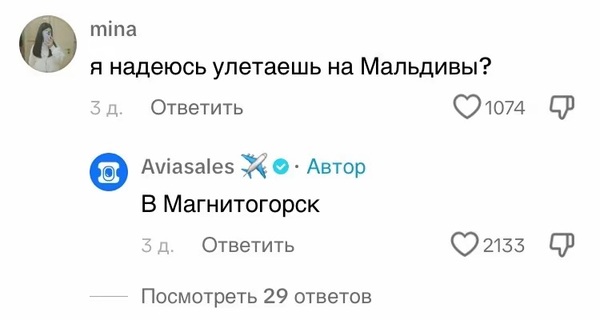
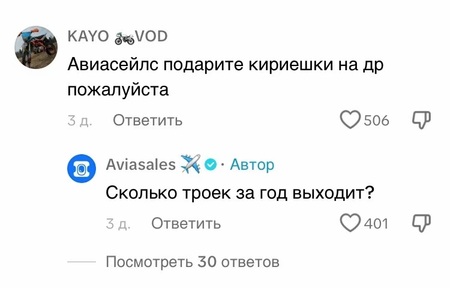
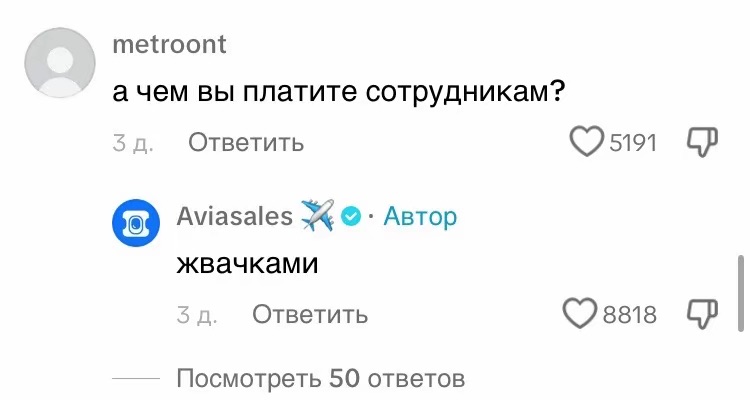
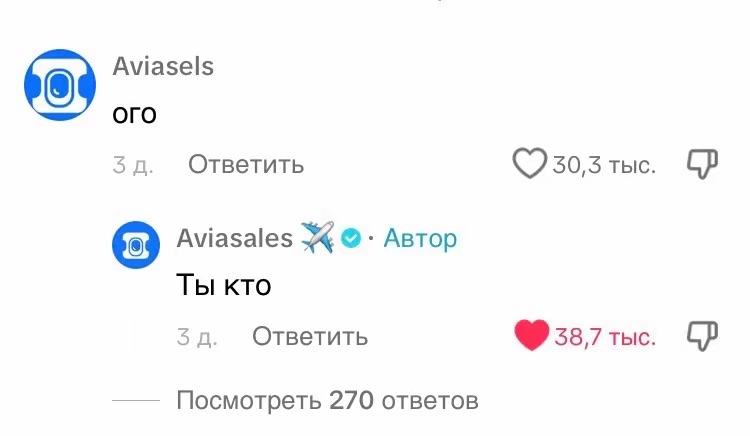
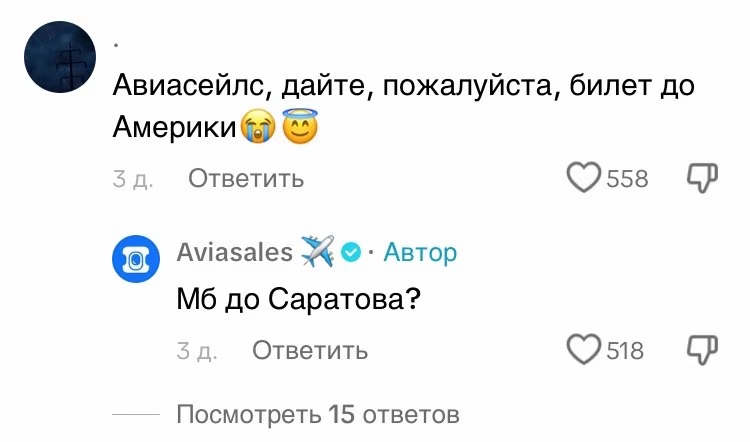
Secondly, a frequently used strategy — or, in other words, a PR tactic — is commenting: the brand’s account actively spreads jokes under other people’s videos and posts.
Whether it is their own wordplay or meme-style responses to equally humorous comments, this happens across a wide variety of posts — both their own and those of others. One of the key characteristics is that Aviasales does not behave like a corporation, but rather like an ordinary social media user — one might even say, like a real person. No matter where you are, which platform you are on, or what posts you are looking at, you can still come across Aviasales. On the one hand, this may seem annoying, but on the other hand, it is a clever strategy to constantly remind people of your existence everywhere.
(*) Instagram is a social media platform developed by Meta, which is recognized as extremist and banned in the Russian Federation.





Thirdly, one of the most important strategies is influencer marketing. In other words, purchasing advertising integrations from comedians and bloggers — some of whom live abroad as emigrants.
Стендап клуб номер 1, скрин шоу
This approach works well for the brand because such content creators also target a fairly young audience with a well-developed sense of humour. Moreover, in this kind of collaboration, the transition to the advertisement often becomes part of the show, or does not feel contradictory at all. This is because Aviasales, thanks to the tactics described earlier, has itself become a kind of meme.
Theoretical Framework
To analyse Aviasales' communication strategy, two theories are used.
The first is the Uses and Gratifications Theory (U&G), developed by Katz, Blumler, and Gurevitch in 1973.
This theory argues that people do not consume media content passively; instead, they actively choose it to satisfy their needs. Four groups of needs are identified: information, personal identity, social interaction, and entertainment. In the context of social media, U&G explains why users follow certain brands — often not for direct practical benefits, but for emotions and a sense of self-identity.
In the case of Aviasales, this theory helps to understand why meme-based content works. Users do not follow the brand’s social media accounts primarily to search for cheap flights — for that, they can use the website. Instead, they come for entertainment and identity. Memes about emigration, crisis, and absurd situations help meet the need for emotional release. At the same time, the feeling of «I understand this joke, so I belong here» strengthens the identity of a young, irony-driven audience. Aviasales builds loyalty not through rational benefits but through emotional connection.
Furthermore, by choosing emigrant comedians for advertising, the brand reaches an audience that seeks validation of its identity — «I am not alone; there are others who have gone through the same experience.» In this context, Aviasales is perceived not as a seller, but as «one of us», which increases brand recognition.


Скриншот аккаунта авиасейлс X & Скриншот рилса в инстаграм Авиасейлс
The second is the Dialogic Communication Theory, proposed by Kent and Taylor in 1998.
This theory describes the principles of effective communication in a digital environment: a brand should not simply broadcast monologues, but rather engage in dialogue, be accessible, behave like a real person, acknowledge mistakes, and provide feedback.
In the case of Aviasales, this theory explains why their «ubiquitous audacity» works rather than annoys people. First, the brand not only replies to comments on its own posts but also shows up on other accounts, leaving meme-style comments. This creates the effect of an «omnipresent character» — the brand is perceived as a living friend who manages to be everywhere at once. Traditional dialogic theory suggests that a brand should be available for dialogue on its own territory. Aviasales goes further: it enters other people’s territory and starts a dialogue there.
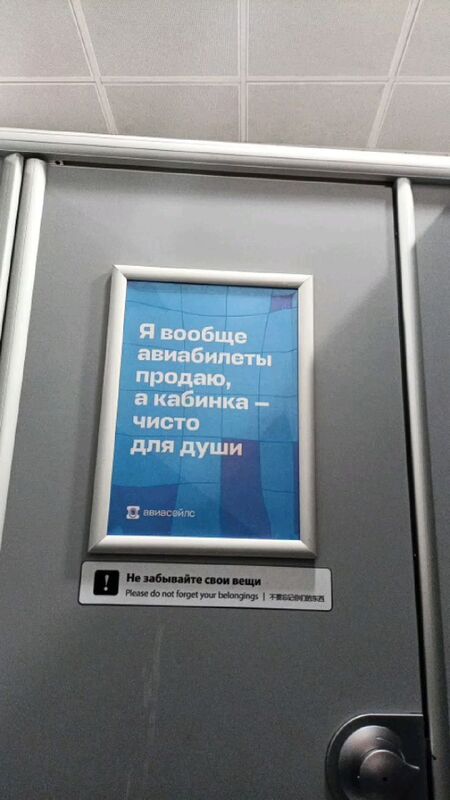

Second, the brand speaks the audience’s language — memes, hyperbole, self-irony. Their replies to comments are not generic templates like «Thank you for your feedback, please contact support.» This breaks down the barrier between a corporation and a consumer.


Third, the brand is not afraid to joke even with potentially dissatisfied commenters, turning risk zones into assets. Aviasales demonstrates that behind the account there is a real person (or a team with a shared sense of humour) who is willing to spend time engaging in conversation.
Analysis
The application of the Uses and Gratifications Theory to Aviasales' strategy shows that the brand has intuitively — or perhaps consciously — overturned the traditional model of communication between a company and a consumer. According to U&G, the audience is not a passive receiver of advertising; instead, it actively chooses content to satisfy its psychological and social needs. Aviasales clearly understands that for finding cheap flights, there is its website and app — that is where the rational task is solved. Users go to social media for something else — primarily for emotional release.
In practice, this is achieved through irony and a meme-driven approach. Consider the visual evidence: a screenshot of a post from Aviasales Uzbekistan on Threads*, where the brand «sincerely apologises that the website offers cookies».
(*) Threads is a social media platform developed by Meta, which is recognized as extremist and banned in the Russian Federation.
Theoretical analysis shows that this post addresses several groups of needs at once, according to Katz and Blumler.
Entertainment: The absurdity of the situation provokes laughter and serves as a form of escapism. Social interaction: The joke creates a reason for discussion in the comments, making users feel like part of a community. Personal identity: A user who laughs at this confirms their belonging to a generation familiar with digital slang.
Aviasales deliberately abandons the role of an «informant» (it does not say: «Buy discount tickets here») in favour of the role of a «clown» or a «friend». This increases brand recognition, as noted in the theoretical section, because an emotional connection works on a deeper level than rational benefit. A person remembers not the ticket price — which is more or less the same everywhere — but the feeling of «someone here understands me.»