Essay
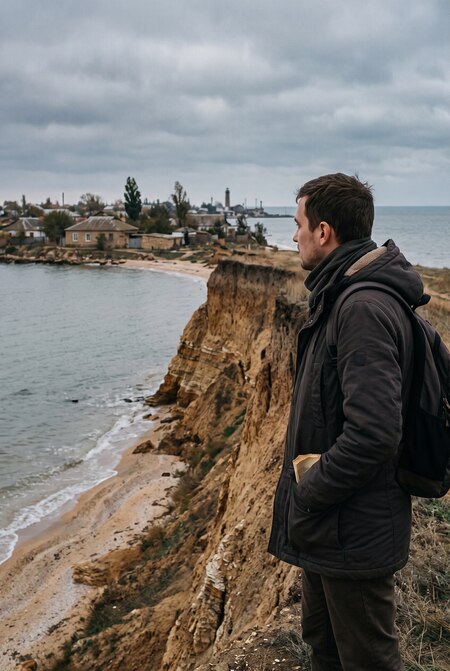
Andrei stood on the edge of a cliff where the old Genichesk meets the Sea of Azov. In his pocket was a yellowed scrap of paper—a page from his great-grandfather’s diary bearing only one phrase:
«Gold does not shine where the White Merchant rules. It warms those who know how to listen to silence.»
For him, it was more than just a fairy tale. Having grown up on stories of underground passages, he felt that the city beneath his feet was not merely foundations of shell limestone, but rather a giant, slumbering beast whose silent, vein-like tunnels teemed with secrets. He had come here to find the answer to where his ancestor had gone—a man who once served the richest and most dangerous figure on the coast.
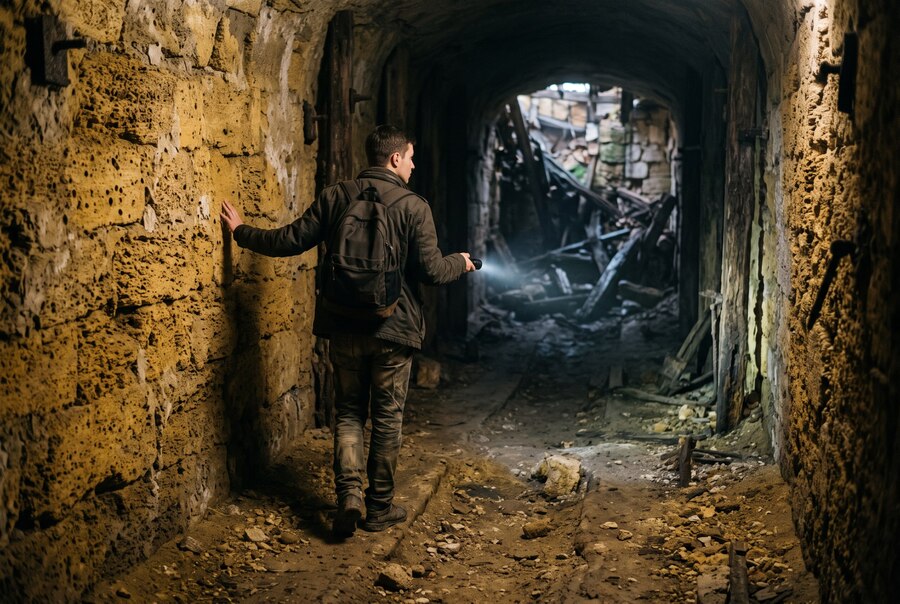
The entrance was found where Andrey never intended to look—under the ruins of the old salt warehouse right by the port. Descending into the darkness, the young man immediately sensed a change: the heavy, damp air smelled of the old sea, dried grapes, and a faint aroma of expensive tobacco. The flashlight beam illuminated porous walls of yellow stone in the void, and small pebbles crunched underfoot. Down here, time seemed to stand still. Andrey walked slowly, touching the walls with his palm, and it felt as though the stone still held the vibration of heavy carts that once rolled here toward the Arabat Spit, concealing forbidden cargo from public view.
At one turn, where the gallery widened to the size of a roadway, Andrey stopped. Ahead, in the trembling haze of underground vapors, he perceived the silhouette of a tall figure in a dazzling white suit—entirely out of place in the dampness. The legendary White Merchant stood with his back to him by the brickwork, seemingly pointing at the wall with a cane. At that moment, his hearing caught a distant, muted chime—exactly as if hundreds of gold coins were pouring onto the stone floor. Andrey felt no fear, only a strange, all-consuming melancholy. The sound grew clearer, mingling with the roar of the waves, which, according to legend, broke directly above the secret tunnel laid beneath the strait.
Approaching the spot where the ghost of his imagination had just stood, Andrey discovered a fresh collapse behind which was visible an old oak door reinforced with iron—the very entrance to the «Golden Passage.» However, recalling the ending of the legend about the sealed-away builders, he hesitated.
In that moment, the realization struck him: the White Merchant was not guarding gold, but his great sin—the betrayal of those who had forged this path. The smugglers' treasures were steeped in blood and deception, and the treasure hunters who had vanished here over decades had simply become part of an eternal watch. Andrey understood that he could not open this door without becoming a part of that chain.
He did not touch the lock, but picked up the only thing from the floor—a small, old ivory button. It was all that remained of his great-grandfather, a faithful servant whose path had ended somewhere here. When Andrei emerged to the surface, the sun was already setting over the horizon, painting the water a blood-gold color. He turned toward the ruins and grasped the fundamental truth of the catacombs: the true legend of Henichesk is not the buried riches, but the living memory that, like sea salt, permanently embeds itself in the earth and the souls of people.